
AI/ML as a Force Multiplier
Why It Matters
Most “AI for labs” fails for one simple reason:
It tries to replace the human.
Real value comes from something else:
AI embedded at the implicit decision points where humans already work.
Calibrations.
Quality checks.
Drift detection.
Classification.
Go / no-go decisions.
Parameter nudges.
Workbooks turn those daily routines into deterministic, AI-assisted workflows — safely.
Not AI going wild.
AI doing the work you already do, but faster and more consistently.
Deterministic Agency
Workbooks are designed for bounded intelligence.
They run inside a structured environment with:
- Explicit inputs
- Defined outputs
- Logged actions
- Clear stop conditions
- Human-in-the-loop control when needed
This is how you get real agency in industrial systems:
Determinism first.
Intelligence second.
A Built-In Framework + User Extensions
Workbooks ship with built-in templates and examples.
And they are extensible:
- Versioned workbook definitions
- User plugins supported
- Standard patterns for common tasks
- Reusable UI widgets and logic blocks
If you can define the workflow, you can systematize it.
UI + Logic
Each Workbook has two parts:
1) The UI Layer
Built from structured widgets:
- Charts
- Tables
- Image viewers
- Buttons / toggles
- Status indicators
2) The Logic Layer
Implemented in code:
- Reads internal state
- Calls UnicornOne tools and commands
- Triggers Recipes / Macros
- Records results to immutable logs
- Produces structured outputs
Workbooks are not “notes.”
They are executable workflows.
Calling External AI/ML Models
AI/ML models are called externally over TCP/IP.
But they behave like first-class tools:
- Models load automatically when a workbook starts
- Execution is bounded by workflow logic
- Outputs are structured and logged
- Decisions are explicit and traceable
This makes advanced AI usable without turning your control system into a science project.
Real-Time Examples
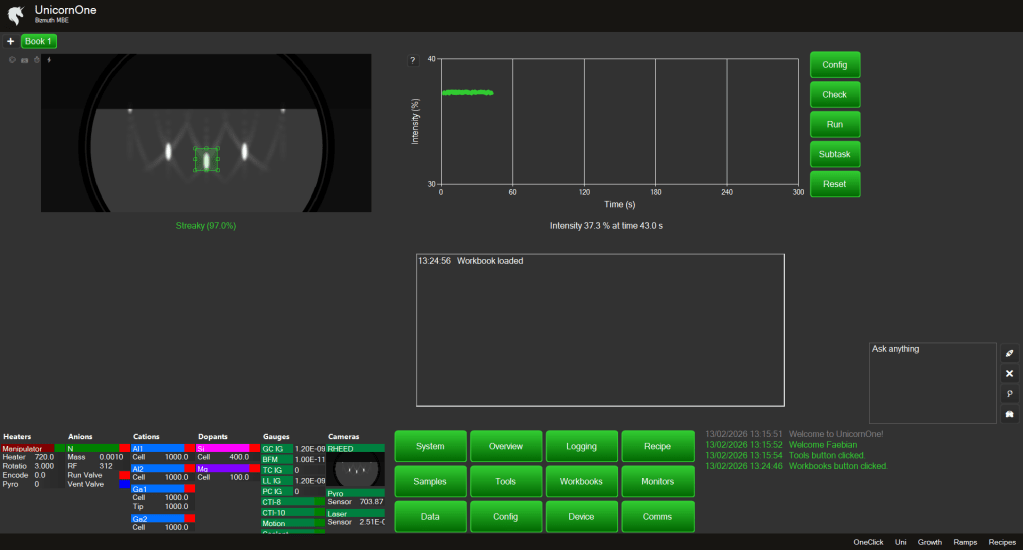
Frame-by-frame RHEED image analysis at ~14 ms latency.
- Live classification
- Automated annotation
- Drift detection
- Transition recognition
ROI intensity analysis + auto-annotation.
- Extracts features continuously
- Labels events
- Creates clean datasets for training and improvement
The rule is simple:
If a human can do it — and historically had to —
you can train an AI to do it for you.
Safely.
The Philosophy
Workbooks are not “automation for the sake of automation.”
They are how you:
- Reduce repetitive manual work
- Increase consistency and throughput
- Capture operational knowledge
- Create clean datasets
- Embed AI where it actually belongs
Less time calibrating.
More time imagining what’s possible.
 Bizmuth