
A User-Developed Plugin
Developed at PDI Berlin
Why It Matters
Most control systems are closed.
If you want something new:
You wait.
You request.
You compromise.
UnicornOne was designed differently.
A protected, stable core.
User-extensible logic.
This plugin demonstrates what that makes possible.
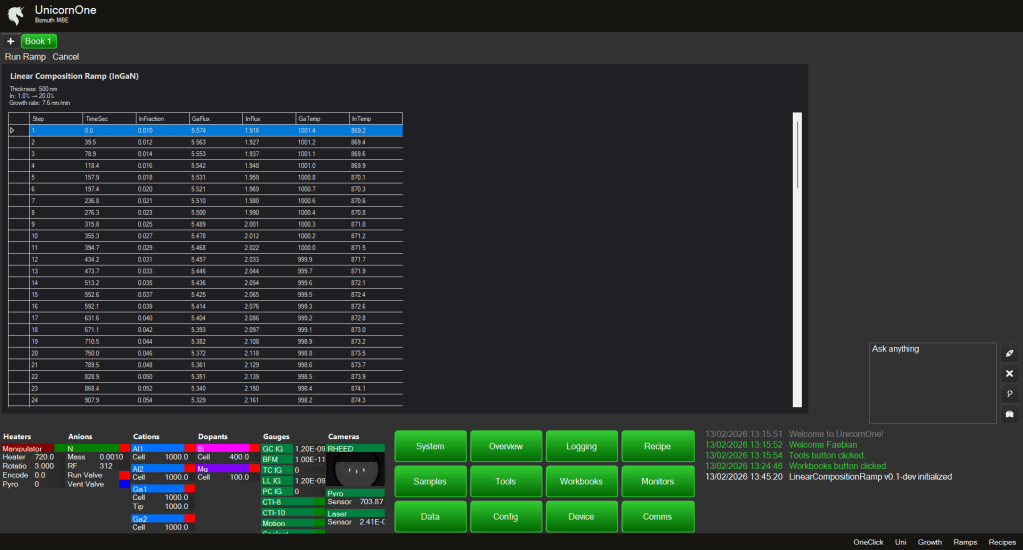
The Objective
Create a virtually linear composition gradient across 500 nm.
Not stepwise.
Not approximate.
Truly linear.
With:
- Correct temperature ramping
- Correct flux balancing
- Clean transitions
- No unintended regime shifts
The Approach
The plugin:
- Uses internal Flux tool models
- Computes required per-element net flux
- Generates a 100-layer stack sequence
- Adjusts temperature dynamically to preserve linear incorporation
- Compensates for desorption kinetics
- Produces a deterministic recipe block
No spreadsheet.
No manual scripting.
Just structured physics inside the control plane.
The Result
The gradient worked.
First run.
Not tuned afterward.
Not iterated five times.
Not corrected post-growth.
First time.
Because it was engineered from structured flux data and calibrated models.
Sovereign Software in Action
This plugin was developed by the user.
Not by the UnicornOne core team.
The core remains:
- Protected
- Stable
- Deterministic
The extensions remain:
- Domain-specific
- User-controlled
- Transferable
This is sovereign software:
A strong foundation.
Extensible intelligence.
The Deeper Lesson
When:
Flux modeling
Temperature calibration
Structured recipes
Metrology feedback
Live inside one architecture—
You can design gradients.
Not hope for them.
Amazing. Instructive. Transferable.
This is not a one-off trick.
It is a demonstration of what becomes possible when:
Users are empowered to extend the system safely.
And when physics is encoded, not approximated.
 Bizmuth