
AI-Orchestrated GaN Growth Calibration
Made in partnership with PDI Berlin
Why It Matters
GaN growth on sapphire looks simple.
In reality, two questions determine success:
- What is the true substrate temperature?
- Are you in the correct metal-rich regime — not N-rich, not droplet formation, but stable bilayer growth?
Traditionally, answering these requires:
- Iteration
- Experience
- Trial samples
- Manual interpretation
- Time
GaN Live turns this into a structured, AI-assisted workflow that alone saves you upto 55k€ per year in OPEX run costs and has an ROI of ❤ months.
The Challenge
1) Determining Substrate Temperature
Thermocouples lie.
Optical pyrometry drifts.
Surface temperature under III-only flux depends on desorption kinetics.
You cannot simply trust the setpoint.
2) Determining Growth Regime
Under III + N flux, growth can be:
- N-rich
- Ga droplet forming
- Proper metal-rich bilayer
The distinction is subtle but critical.
RHEED contains the signal.
But interpreting it reliably requires experience.
The Workbook
GaN Live is an interoperable Workbook.
It has already been transferred between systems.
Same logic.
Same models.
Different hardware.
Components
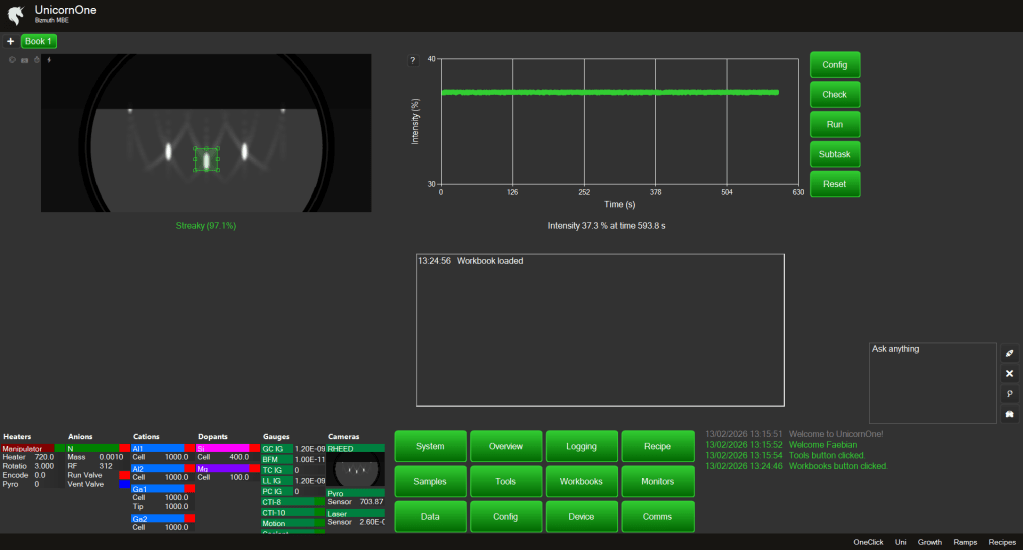
RHEED Widget
Live feed integrated directly into the workflow.
AI/ML Model #1
Frame-by-frame RHEED classification:
- Streaky vs spotty
- Pattern quality assessment
- Surface reconstruction awareness
Latency: ~14 ms per frame.
AI/ML Model #2
Intensity envelope analysis:
- Oscillation envelope tracking
- Transition time detection
- Regime change identification
This same model is used twice — with different goals.
Step 1 — III-Only Flux
Under III-only conditions:
Using:
- Activation energies
- Logged experimental history
- Desorption modeling
- Flux tool integration
We determine desorbing flux.
From desorbing flux, we calculate real substrate temperature.
Not the heater temperature.
The surface temperature.
Step 2 — III + Nitrogen
With both III and N supplied:
Using the same intensity envelope model, the goal shifts:
Determine:
- N-rich
- Droplet formation
- Proper metal-rich bilayer growth
The system identifies the correct regime automatically.
Not by guessing.
By structured signal interpretation.
Interoperable by Design
This workflow:
- Runs on different systems
- Uses structured RHEED input
- Pulls calibration from Flux tools
- References logged historical data
It is not hard-coded to a single reactor.
It is architecture-driven.
Performance
Total runtime: 33 minutes.
Manual alternative: ~2+ hours per sample.
Savings:
- ~2 hours per run
- Reduced human error
- Consistent regime identification
Estimated impact:
~55,000 € per system per year.
ROI < 3 months.
The Deeper Value
GaN Live is not just automation.
It demonstrates:
- Deterministic AI at defined decision points
- Integration between metrology and flux modeling
- Cross-system portability
- Physics-informed machine learning
It shows what happens when:
Control
Metrology
Modeling
AI
Operate inside one coherent system.
 Bizmuth