
From Control to Understanding
Why It Matters
Most labs operate equipment.
Few truly model it.
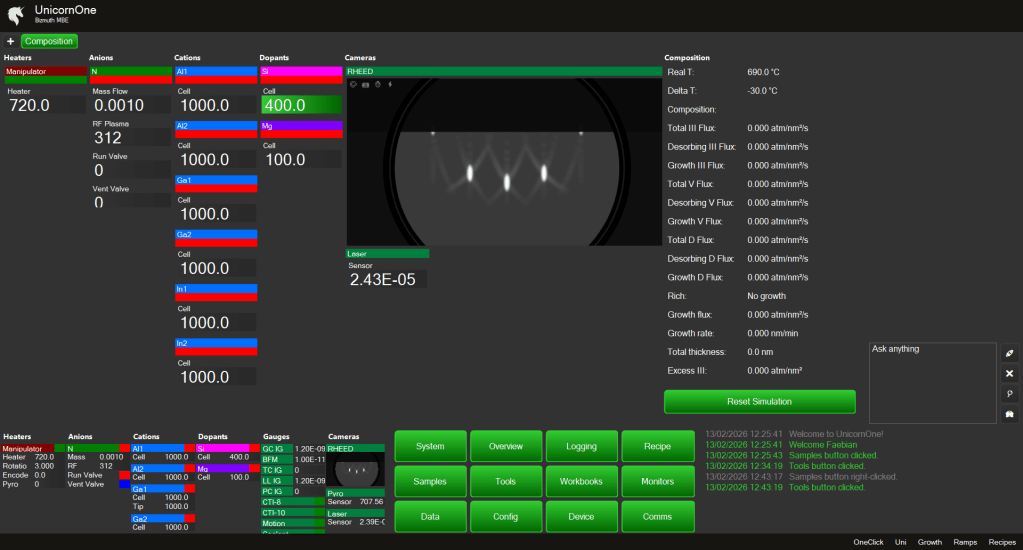
A control system executes commands.
A monitoring system records signals.
But a model explains what is happening beneath the signals.
That is the difference.
And that difference compounds.
Simulator vs Digital Twin
Simulator
A Simulator is a fully synthetic system.
It mimics real-world behavior based on:
- Known physics
- Empirical observations
- Process assumptions
- Measured correlations
No hardware is required.
It is a sandbox for your current understanding.
Digital Twin
A Digital Twin is a live model.
It ingests real hardware data:
- Temperatures
- Pressures
- Flux values
- RHEED intensity
- Reflectance signals
- Rotation state
It predicts internal system state in real time.
It does not replace hardware.
It mirrors it.
And when prediction diverges from observation — that gap becomes insight.
Modeling as Documentation
When you build a simulator, you are forced to answer:
- What happens to RHEED when the Ga shutter opens?
- What happens to laser reflectance when rotation starts?
- What layers actually grow at this temperature and flux?
- How does adatom accumulation evolve over time?
You encode that knowledge into structure.
What used to live in:
- Lab notebooks
- Tribal memory
- External wikis
Becomes executable understanding.
Your documentation becomes operational.
Synthetic Data at Scale
Simulation unlocks something most labs do not have:
Clean, structured, controllable data.
You can:
- Generate synthetic datasets
- Fill gaps in sparse measurements
- Create parameter variants
- Inject controlled noise
- Add ambiguity
- Auto-annotate data
In minutes.
This accelerates:
- AI training
- Model validation
- Edge-case exploration
You are no longer limited by experimental throughput.
AI Sandbox
Before deploying AI to real hardware, you can:
- Test decision logic
- Explore feedback strategies
- Validate anomaly detection
- Stress-test process logic
In a safe environment.
No risk.
No wasted wafers.
No hardware damage.
Simulation becomes a proving ground.
From Simulator to Digital Twin
With a single configuration change, the Simulator can become a Digital Twin.
Real signals are routed into the model.
The synthetic world becomes synchronized with reality.
It:
- Echoes expected system behavior
- Predicts internal state
- Highlights divergence
That divergence is not failure.
It is opportunity.
A Simple but Powerful Example
During GaN growth, adatom accumulation builds on the surface.
In UnicornOne, the simulator can:
- Model surface adatom density
- Track Ga reservoir behavior
- Predict transition thresholds
These are not abstract numbers.
They are real-time values representing physical atoms.
When a predicted accumulation threshold aligns with a real RHEED transition, the effect is striking.
The invisible becomes visible.
What felt like intuition becomes structured knowledge.
The Compounding Effect
The impact is not immediate.
It compounds.
Over time:
- Models improve
- Predictions sharpen
- AI training strengthens
- Experiment design accelerates
- Understanding deepens
The system shifts from reactive control to predictive insight.
The Philosophy
Control systems execute.
Monitoring systems record.
Simulation systems understand.
UnicornOne offers both a Simulator and a Digital Twin because control without understanding is fragile — and understanding without structure is theoretical.
Together, they turn operation into exploration.
 Bizmuth