
Surface Physics, Uncompromised
Why It Matters
For most labs, RHEED is:
- A camera feed
- A couple of ROIs
- An intensity trace
- A vendor UI that hasn’t evolved in decades
The physics is rich.
The software is not.
Surface reconstructions, Kikuchi lines, sub-lattice features — they are there.
But often buried in background noise, compression artifacts, or poor dynamic range.
RHEED should be a surface microscope in real time.
Not a dim viewer.
Full Analytical Control
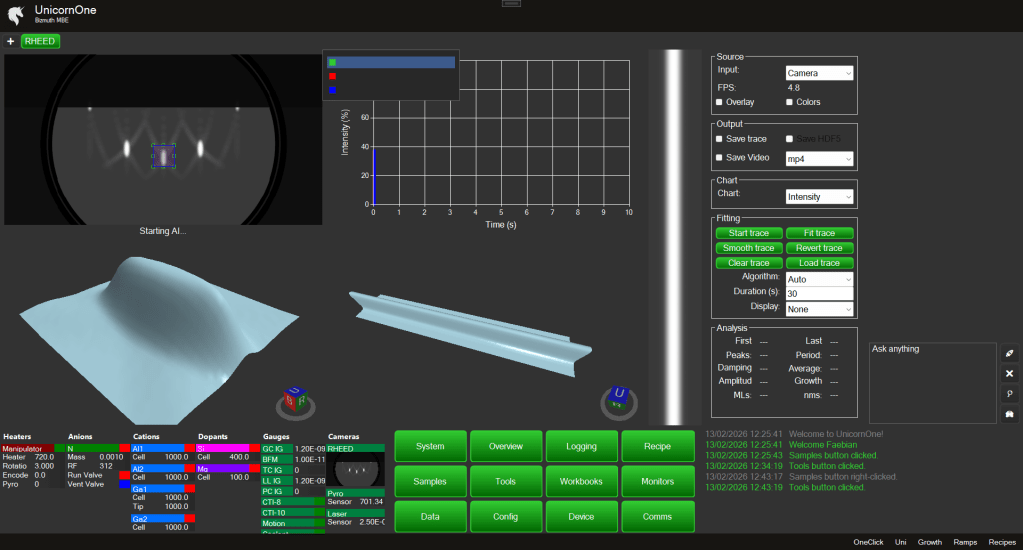
UnicornOne’s RHEED module replaces traditional standalone RHEED software entirely.
It includes:
- ROI creation and coloring
- Multi-ROI intensity tracking
- ROI profile scans
- Line scans
- Time-resolved pixel mapping
- Time-resolved 3D surface contours
- Oscillation auto-fitting (after first full oscillation)
- LUT tables (default + custom)
- External analysis filters via plugin (DFT, custom transforms, etc.)
All operating inside the control plane.
Not as a detached viewer.
Oscillation Intelligence
After the first full oscillation, the system can:
- Auto-fit oscillation period
- Predict growth rate
- Track drift
- Detect damping
- Flag anomalies
This ties directly into Flux and growth modeling.
RHEED stops being “monitoring.”
It becomes quantitative.
HDR Mode — Real High Dynamic Range
Developed in collaboration with users at PDI Berlin.
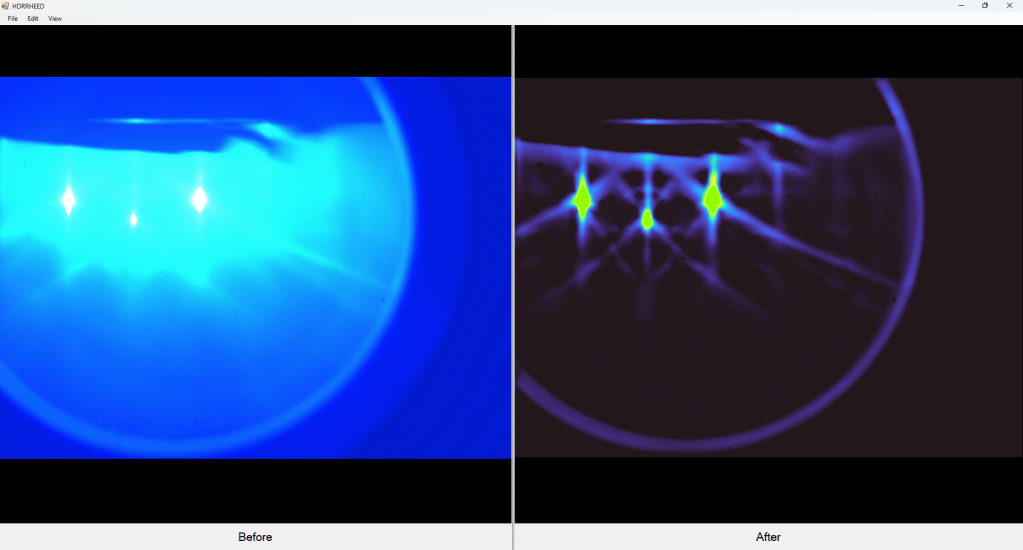
This is not a cosmetic filter.
It is per-frame HDR processing with ~25 ms latency.
It:
- Removes background intelligently
- Enhances streak contrast
- Reveals hidden reconstructions
- Brings out Kikuchi lines
- Highlights sub-lattice features
Features researchers have physically had access to for 50 years — but software rarely exposed clearly.
HDR mode is a switch.
Seeing is believing.
Adaptive Analysis via Plugin
The RHEED pipeline is extensible.
Plugins can:
- Perform adaptive fitting
- Apply temperature-calibrated intensity models
- Adjust for growth mode transitions
- Pull calibration data from Workbooks
- Execute user-defined analysis routines
GaN intensity modeling.
Temperature-dependent behavior.
Custom research workflows.
RHEED becomes programmable.
True Lossless Capture
You can record:
- Full video streams (MP4, MKV, AVI, HFYUV)
- Intensity traces
- HDF5 (int16 array) for true 100% lossless capture
Every pixel.
No compression artifacts.
Publication-ready datasets.
RGB Packed Bit Encoding
UnicornOne offers a unique RGB packed-bit encoding method:
- Capture 8-bit to 16-bit camera data
- Losslessly compress into RGB image frames
- Recover original pixel values exactly
- Transfer across programs without data loss
No silent degradation.
What you record is what the camera saw.
Universal Camera Pipeline
From:
- USB webcams
To: - 16-bit industrial SDK cameras
The pipeline is unified.
Features include:
- Mouse-wheel zoom
- Multiple concurrent views
- Zero additional display latency
- Latency monitoring across full pipeline
You can prove your latency is 25 ms.
And you can see the difference.
Integrated Everywhere
RHEED is not confined to one window.
It appears:
- In the System cockpit
- In Overview
- Inside Recipes
- Within Logging
- In Workbooks
Without duplicating processing.
Without adding latency.
Surface feedback becomes structural.
The Experience
You have never experienced RHEED like this.
Not because the physics changed.
But because the software finally respects it.
Once you see streaks emerge clearly in HDR.
Once you correlate oscillations with flux modeling in real time.
Once you record truly lossless surface evolution—
You do not go back.
 Bizmuth