
From Incident Beam to Net Growth
Why It Matters
Beam Flux Monitor tells you what leaves the source.
Flux tells you what actually incorporates.
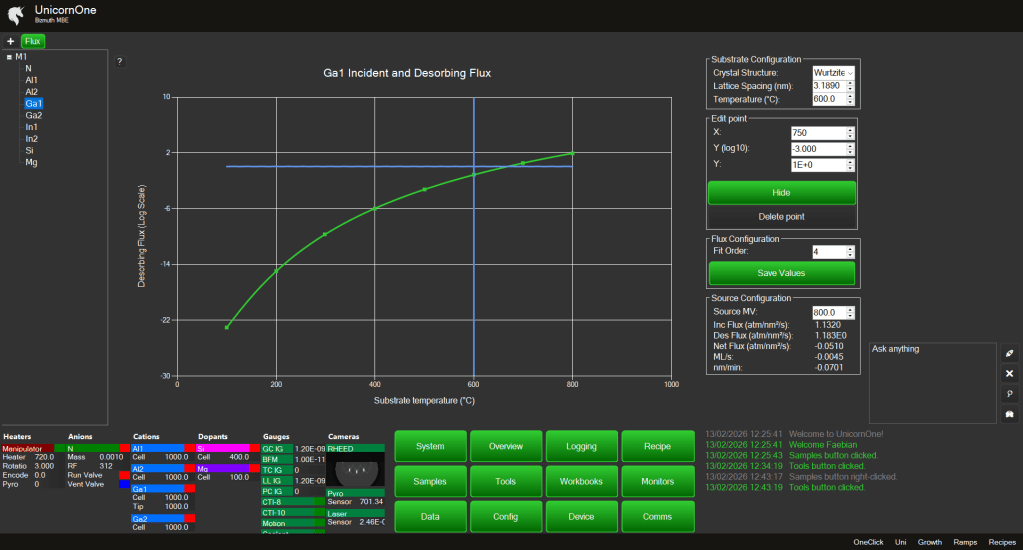
Between those two lies everything that matters:
- Desorption
- Surface kinetics
- Temperature dependence
- Elemental interactions
Incident flux alone does not define growth.
Net flux does.
Incident Flux Is Only the Beginning
From BFM, you already know:
Actuator → BEP → Incident Flux (atoms / nm² / s)
But not every atom that arrives stays.
At real substrate temperatures:
- Ga can desorb
- In can desorb
- As can re-evaporate
- Nitrogen activation efficiency varies
Surface chemistry is dynamic.
Flux models this reality.
Net Flux per Element
Flux takes:
- Incident atomic flux
- Substrate temperature
- Desorption models per species
- Interaction assumptions
And computes:
Net incorporation flux per element.
Element by element.
Now you are not guessing at stoichiometry.
You are calculating it.
Species-Level Prediction
With structured net flux, you can begin predicting:
- Alloy composition
- Growth rate
- Doping incorporation
- Effective V/III ratio
- Stoichiometric windows
Per element.
Not empirically.
Mechanistically.
Modelling Interactions
Once you have per-element net flux:
You can model:
- Surfactant effects
- Competitive incorporation
- Composition gradients
- Intentional doping profiles
- Dynamic alloy tuning
Complex gradients become programmable.
Not trial and error.
Real-World Example
We applied this to InGaN.
Linear composition gradient.
First run.
Not luck.
Not tuning by feel.
Structured flux modeling from calibrated data.
From measurement.
From engineering.
Engineering, Not Intuition
Flux shifts growth from:
“Let’s try and see.”
To:
“We know what this actuator change will do at this temperature.”
It connects:
Control → Measurement → Surface Physics → Composition
Inside the same system.
The Philosophy
Incident beam tells you what arrives.
Net flux tells you what grows.
When you can quantify incorporation, you stop reacting to results.
You design them.
Flux turns metrology and calibration into predictive material engineering.
 Bizmuth