
From Source Setting to Atomic Flux
Why It Matters
Every epitaxy system has the same hidden chain:
Actuator → Source Behavior → Beam Equivalent Pressure → Incident Flux → Growth
Most operators control the first link.
Few quantify the last.
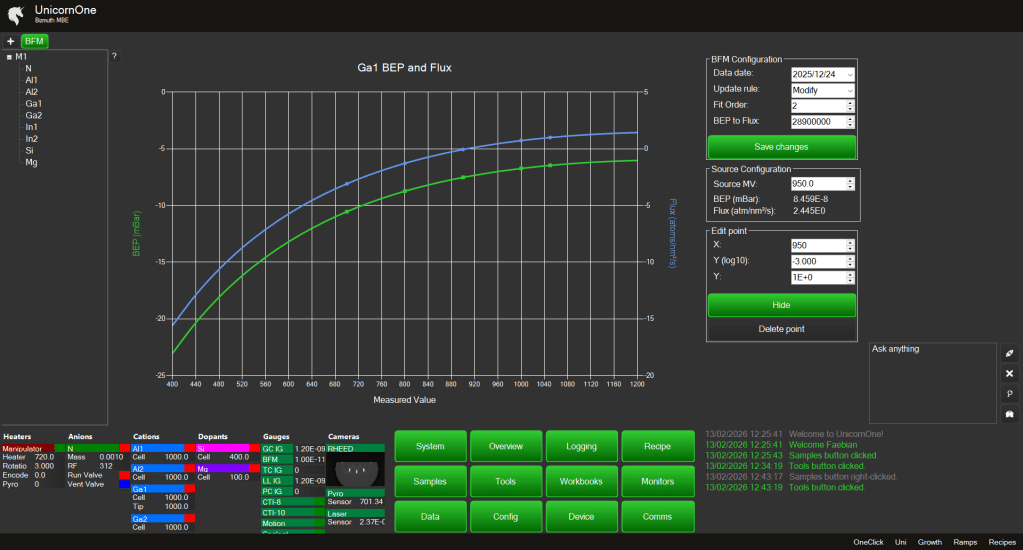
Beam Equivalent Pressure (BEP) is often treated as a stepping stone — checked occasionally, written down, then forgotten.
But if structured properly, it becomes predictive.
Actuator to BEP
Each source has an actuator:
- Effusion cell temperature
- Valve position
- Mass flow controller
- RF power
Changing that actuator changes flux.
UnicornOne lets you:
- Record BEP easily
- Log it automatically during recipes
- Sweep actuator variables to gather structured datasets
Instead of isolated calibration points, you build a range.
Structured Visualization
The BFM tool allows you to:
- Review historical BEP data (hours, days, weeks)
- Overlay multiple sources
- Fit data using different models
- Compare past calibrations
You are not guessing at flux behavior.
You are modeling it.
Predictive Fitting
From structured BEP datasets, UnicornOne can:
- Fit BEP vs actuator value
- Store calibration curves
- Predict BEP from a given source setting
Example:
Ga cell at 1000°C → 1.4E-6 mbar BEP
No manual interpolation.
No spreadsheet dependency.
Just structured prediction.
From BEP to Incident Flux
BEP is not the final goal.
Incident atomic flux is.
Using external calibration methods:
- XRD thickness calibration
- SEM cross-section
- RHEED oscillations
You determine substrate-invariant incident flux in:
atoms / nm² / s
UnicornOne lets you attach this calibration layer to the BEP model.
Now your system knows:
Actuator → BEP → Atomic Flux
Quantitatively.
Why This Is Powerful
Once you know incident flux, you can begin predicting:
- Growth rates
- Alloy composition
- Doping levels
- Stoichiometry windows
BFM becomes more than a monitor.
It becomes a predictive engine.
Automatic Recipe Integration
BFM can be called directly inside a recipe to:
- Sweep temperature ranges
- Auto-record BEP
- Generate calibration curves
- Store results under ProcessID
Calibration becomes reproducible and logged.
Not tribal memory.
The Bridge to Flux
BFM quantifies the beam.
The Flux tool (its sister module) interprets what those beams mean for material growth:
- Composition
- Incorporation
- Stoichiometry
- Growth kinetics
Together, they move you from pressure readings to atomic control.
The Philosophy
Control without quantification is approximate.
Quantification without structure is fragile.
BFM gives you structured, reproducible control over atomic flux — and lays the foundation for predictive growth modeling.
 Bizmuth