
The Full State, Without the Noise
Why It Matters
In complex processes, overwhelm is subtle.
You either:
- See too little and miss context
or - See too much and lose focus
Operators shouldn’t have to choose between minimalism and completeness.
They need both — at the right moment.
HUD vs Overview
The HUD (inside System) shows what matters now.
- Active PID MV
- Current ramp
- Immediate alerts
- Running recipe step
It is time-critical.
The Overview is its comprehensive sister view.
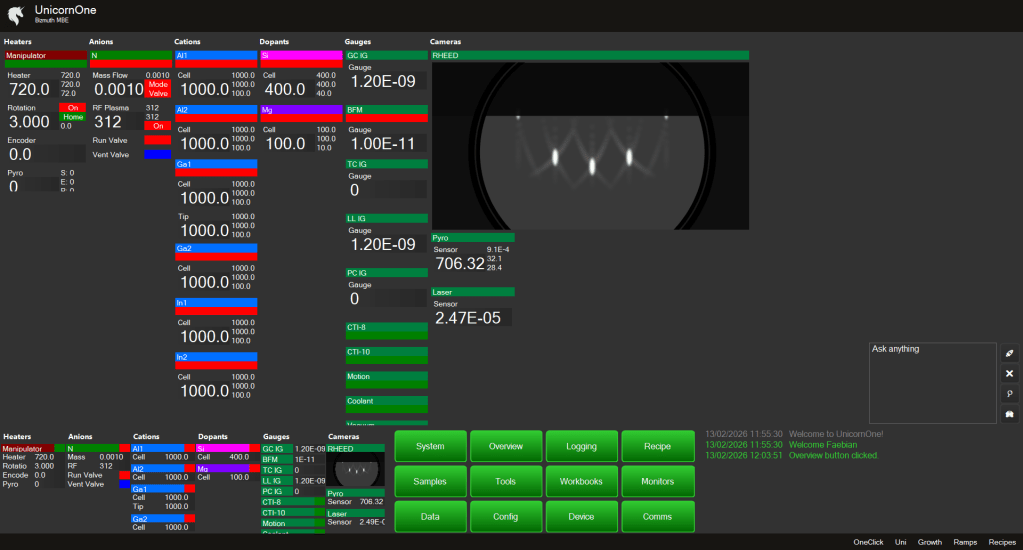
It shows the whole captured state.
Using your example:
HUD shows:
- PID MV
Overview shows:
- MV
- SP
- EP
- OP
- Related variables
- Device state
Same layout philosophy.
Larger widgets.
More structure.
Deeper context.
Structured Clarity
Overview is not a data dump.
It is carefully organized.
- Color-coordinated labels
- Grouped component families
- Consistent UI/UX patterns
- Logical visual hierarchy
Heaters grouped with heaters.
Sources grouped with sources.
Tools grouped with tools.
Pressure gauges look like pressure gauges.
PIDs behave like PIDs.
Signals align visually with control structure.
Control and Metrology — Side by Side
In most systems, metrology feels separate.
Overview removes that artificial divide.
RHEED intensity.
Laser reflectance.
Pyrometer temperature.
Pressure signals.
They sit alongside control loops.
Not as secondary plots.
As first-class process signals.
You see them the same way you see a PID.
Because they are part of the loop.
Depth Without Overwhelm
Overview lets you:
- Expand a component family
- Inspect related variables
- Dive one layer deeper
Without jumping windows.
Without breaking layout.
Without losing orientation.
You get the deeper heads-up — when you want it.
The Philosophy
Overview is about focus through structure.
All relevant levers.
Clear grouping.
Consistent visual language.
No ornamental clutter.
It gives you context without chaos.
And it ensures that when something drifts, you don’t hunt for it.
You see it.
 Bizmuth